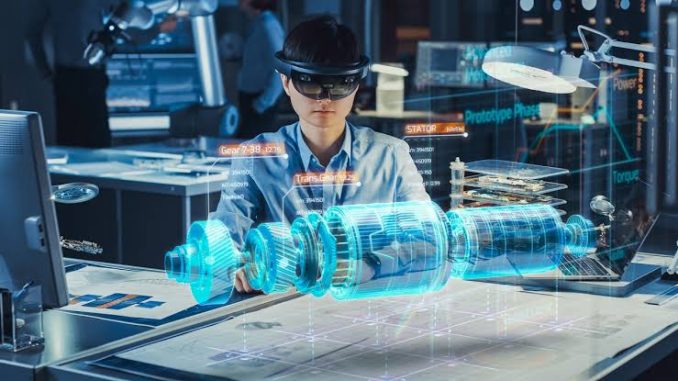
“The Rise of Augmented Reality: Transforming Experiences Across Industries”
Augmented Reality (AR) has emerged as a transformative technology, blurring the lines between the physical and digital worlds and revolutionizing the way we interact with information, objects, and environments. From entertainment and gaming to education, healthcare, and retail, AR is reshaping experiences across industries and unlocking new opportunities for innovation and engagement. In this article, we explore the rise of augmented reality, its applications, benefits, and implications for businesses and consumers alike.
At its core, augmented reality overlays digital content, such as images, videos, and 3D models, onto the real-world environment, enhancing the user’s perception and interaction with their surroundings. Unlike virtual reality, which immerses users in entirely digital environments, AR enriches the real world with digital elements, creating immersive and interactive experiences that blend physical and digital realities seamlessly.
The roots of augmented reality can be traced back to the 1960s, with the development of early AR systems such as Ivan Sutherland’s “Sword of Damocles,” a head-mounted display that superimposed computer-generated graphics onto the user’s view of the real world. However, it wasn’t until the advent of smartphones and mobile computing that AR began to gain widespread adoption and recognition as a viable technology.
One of the earliest examples of AR’s mainstream success was the launch of Pokémon GO in 2016, a mobile game that used AR technology to superimpose Pokémon characters onto the real-world environment, allowing players to catch, train, and battle Pokémon in their own neighborhoods. The success of Pokémon GO demonstrated the potential of AR to create compelling and immersive experiences that captivate audiences and drive engagement.
Since then, augmented reality has expanded beyond gaming to encompass a wide range of applications and industries. In the entertainment industry, AR is used to enhance live events, concerts, and performances with digital overlays, special effects, and interactive elements that enrich the audience experience. For example, AR-powered apps can overlay information about performers, lyrics, and behind-the-scenes content onto the user’s view of a live concert, providing a more immersive and engaging experience for fans.
Moreover, augmented reality is revolutionizing the way we learn and educate, making complex concepts more tangible and interactive. In education, AR enables interactive textbooks, virtual laboratories, and immersive field trips that bring learning to life and engage students in hands-on learning experiences. For example, AR apps can superimpose 3D models of historical artifacts, scientific phenomena, and geological formations onto the user’s view of the real world, enabling students to explore and interact with these objects in a virtual environment.
Furthermore, augmented reality is transforming the way we shop and experience retail, enabling virtual try-on experiences, interactive product demonstrations, and personalized shopping experiences that bridge the gap between online and offline shopping. Retailers are leveraging AR technology to enhance the customer experience, increase engagement, and drive sales by allowing customers to visualize products in their own space before making a purchase. For example, AR-powered apps enable virtual furniture placement, allowing customers to see how furniture will look and fit in their home before making a purchase.
In healthcare, augmented reality is revolutionizing medical training, surgical planning, and patient care by providing healthcare professionals with immersive and interactive tools that enhance diagnosis, treatment, and communication. AR-enabled medical simulations, surgical planning tools, and patient education apps enable healthcare professionals to visualize complex medical concepts, practice procedures, and communicate with patients more effectively. For example, AR can overlay medical imaging data, such as CT scans and MRI images, onto the patient’s body, providing surgeons with real-time guidance and visualization during procedures.
Moreover, augmented reality is transforming the way we work and collaborate, enabling remote collaboration, virtual meetings, and immersive training experiences that break down geographic barriers and enhance productivity. AR-powered collaboration tools, such as virtual whiteboards, 3D modeling software, and remote assistance apps, enable teams to work together in real-time, regardless of their physical location. For example, AR-enabled remote assistance apps allow field technicians to receive real-time guidance and support from experts, reducing downtime and increasing efficiency.
Despite its many benefits, augmented reality also poses challenges and considerations that must be addressed to realize its full potential. Concerns have been raised about issues such as privacy, security, and ethical implications of AR technology, particularly regarding the collection and use of personal data and the potential for misuse or abuse of AR-enabled applications. Moreover, technical challenges such as hardware limitations, latency, and battery life can impact the user experience and adoption of AR technology.
In conclusion, the rise of augmented reality is transforming experiences across industries, from entertainment and education to healthcare, retail, and beyond. By blending the physical and digital worlds, augmented reality is creating immersive, interactive, and personalized experiences that engage users and unlock new opportunities for innovation and engagement. However, realizing the full potential of augmented reality requires addressing technical, ethical, and regulatory challenges, while also fostering collaboration and innovation across industries to drive adoption and implementation of AR-enabled solutions.